
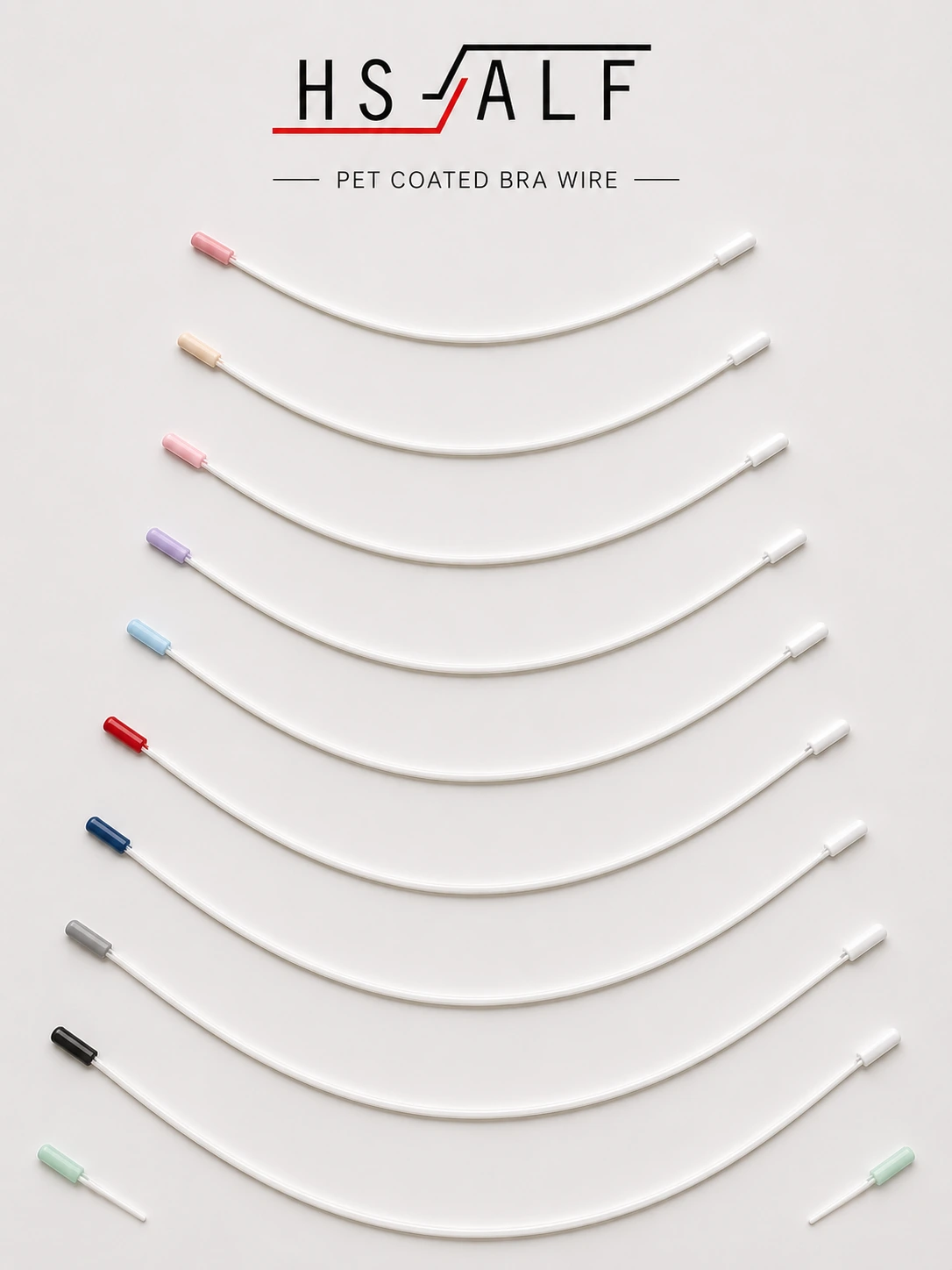
PET Coated Bra Wire
Product Features
PET Coated Bra Wire and Nylon Coated Bra Wire Terminology
HS ALF manufactures PET coated bra wire for professional bra and lingerie production. The market sometimes uses Nylon Coated Bra Wire or Nylon Coated Bra Underwire for this product group; however, HS ALF uses PET, so PET Coated Bra Wire is the technically accurate description. The product is engineered as a complete underwire system rather than simply a plastic-coated steel wire.
High-Carbon Steel Raw Material for Controlled Flexibility
Performance starts with the steel core. HS ALF uses high-carbon steel selected for mechanical strength, controlled flexibility, spring behavior and shape retention. Material quality is critical because an underwire must flex with body movement while maintaining the geometry required to support the bra cup. An unsuitable steel grade can deform in use even when the initial shape is correct.
In-House Wire Flattening and Sensor-Assisted Dimensional Control
The high-carbon steel wire is flattened in-house to obtain the required underwire cross-section. Sensor-assisted control continuously monitors dimensional stability during production. Excessive thickness can create fitting problems in the underwire channel, while insufficient thickness can allow unwanted movement inside the casing. Stable cross-section therefore supports both sewing compatibility and repeatable finished-garment performance.
Galvanizing Before PET: Dual Corrosion Protection
Unlike conventional PET-coated wire that relies only on its outer polymer layer, HS ALF galvanizes the steel before PET coating. The construction is High-Carbon Steel → Galvanized Protective Layer → PET Protective Layer. PET is the primary external barrier; if its surface is damaged, the galvanized layer remains underneath as backup corrosion protection and helps prevent direct exposure of the steel.
In-House Galvanizing, Coating Quality and Salt Testing
Galvanizing is carried out within HS ALF's integrated production process. The quality and continuity of this hidden protective layer matter because cracks, insufficient coverage or irregular coating can weaken the backup corrosion barrier. Expert engineers periodically evaluate corrosion resistance through laboratory salt testing, allowing galvanizing quality to be controlled before the PET layer becomes the final external surface.
In-House PET Coating with Sensor-Controlled Thickness
PET coating is also performed within HS ALF. Sensor-supported coating equipment helps maintain a stable and uniform PET thickness along the wire. Coating consistency affects the final cross-section, surface protection and process repeatability, so PET quality is evaluated not only by appearance but also by thickness stability and adhesion behavior.
Heat-Resistant PET Coating for Tempering and Shape Stability
After customer-specific forming, the underwire undergoes controlled tempering/heat treatment. The PET system is designed to tolerate the temperatures required for this process. Correct heat treatment helps develop elasticity, spring recovery and shape stability. If a coating cannot tolerate sufficient heat, mechanical performance may be compromised; if poor PET is overheated, it can crack or flake when the wire is subsequently bent.
Custom Forming, Tempering and Spring Recovery
Underwire geometry can be developed from a physical customer sample or technical drawing. After forming, controlled heat treatment stabilizes the geometry and supports spring-like recovery toward the intended shape after loading. Once approved, the reference can be recorded by sample-card number and size for consistent repeat orders.
Protective End Coating: Corrosion, Fabric and User Protection
Cut underwire ends require their own protection. HS ALF applies a dedicated protective tip coating that isolates the exposed end, adds corrosion protection and reduces the risk of the sharp metal end damaging the underwire casing or surrounding fabric. Tip-coating quality is critical: low-quality material may detach during repeated movement, exposing metal and increasing corrosion and fabric-damage risk. HS ALF uses a tip system designed for durable adhesion during long-term use, with standard or customer-requested colors.
Standard Dimensions, Custom Sections, Samples and Flexible B2B Supply
Standard PET coated wire sections are 0.74 × 2.02 mm, 0.95 × 2.28 mm and 0.75 × 3.18 mm. Alternative cross-sections can be evaluated for suitable high-volume projects. Samples can be prepared before production. Standard bra wire orders have no fixed piece MOQ, and products can be supplied in HS ALF standard boxes or alternative customer-requested packaging.